Course Type: Course

  • Module 1: Orientation to Contemporary Child Health Care in Iowa

    Module 1: Orientation to Contemporary Child Health Care in Iowa

    There are two sections in this course:

    • Section 1: Contemporary Knowledge of Child Development
    • Section 2: Identifying and Assisting Children with Concerns

    Intended Audience

    Iowa Child Health Care Providers (CHCP), Pediatricians, Family Physicians, Physician Assistants, and Nurse Practitioners

    Learning Objectives:

    After completing this course, participants will be able to:

    • Differentiatebetween surveillance and screening and name one appropriate screening test for social/emotional development and one for Autism for children 18 months of age
    • Statethe three levels used in the Child Health & Development Record (CHDR) and where the most updated versions may be conveniently located and viewed
    • Describetwo important reasons knowledge of a mother’s emotional status in the months following birth may assist a CHCP to enhance the child’s social-emotional health

    Pre-requisites/Learning Level

    No pre-requisites

    Competencies addressed

    Core Competencies for Public Health Professionals identified

    Domain 5: Community Dimensions of Practice Skills

    • 5A2. Recognizes relationships that are affecting health in a community (e.g., relationships among health departments, hospitals, community health centers, primary care providers, schools, community-based organizations, and other types of organizations)
    • Collaborates with community partners to improve health in a community (e.g., participates in committees, shares data and information, connects people to resources)

    CEUs Offered

    None

    Cost

    Free

    Modality/format

    Online Self-Pace

    Length

    1 hour

    Presenter(s) and/or Content Experts

    Steven Wolfe, MD; Alfred Healy, MD

    Technical requirements:

    • Adobe Acrobat Reader 
    • Flash Player 
    • Speakers

    Registration requirements

    Register a free account

    Creation and/or update

    August 4, 2013
  • Module 2: Healthy Social, Emotional & Behavioral Development

    Module 2: Healthy Social, Emotional & Behavioral Development

    There are two sections in this course:

    • Section 1: Healthy Child Development
    • Section 2: Understanding Social Behaviors

    Intended Audience

    Iowa Child Health Care Providers (CHCP), Pediatricians, Family Physicians, Physician Assistants, and Nurse Practitioners

    Learning Objectives:

    Upon completion of this part, you will be able to:

    • Clearly Stateat least three reasons early identification of signs/symptoms of social, emotional and behavioral concerns are vital for a child’s optimal future development
    • Indicateat least two mother-child or family events in which the child’s social-emotional development could be enhanced and
    • State current knowledge of “toxic” stress and how it might permanently and negatively alter future social-emotional and behavioral growth in a child

    Pre-requisites/Learning Level

    No pre-requisites

    Competencies addressed

    Communication Skills, Public Health Sciences Skills, Cultural Competency Skills

    CEUs Offered

    None

    Cost

    Free

    Modality/format

    Online Self-Pace

    Length

    1 hour

    Presenter(s) and/or Content Experts

    Scott Lindgren, PhD and Alfred Healy, MD

    Technical requirements:

    • Adobe Acrobat Reader 
    • Flash Player 
    • Speakers

    Registration requirements

    Register a free account

    Creation and/or update

    August 18, 2013

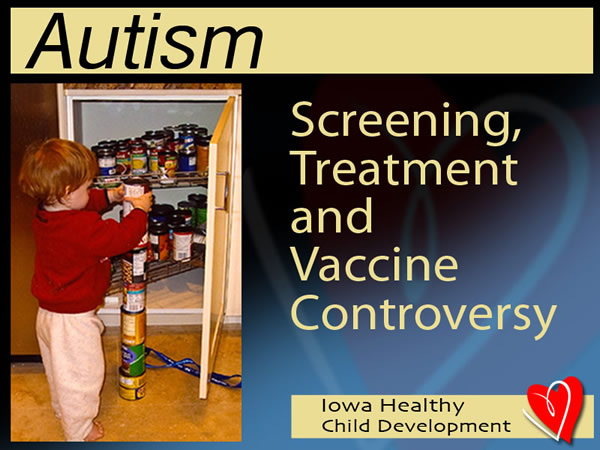
  • Module 3: Autism – Screening, Treatment, and Vaccine Controversy

    Module 3: Autism – Screening, Treatment, and Vaccine Controversy

    This course covers autism – screening, treatment, and vaccine controversy. The content is presented based on the following topics: 

    • Terminology
    • History
    • Prevalence
    • Etiology
    • Clinical Signs
    • Identification and Diagnosis
    • Management

    Intended Audience

    Iowa Child Health Care Providers (CHCP), Pediatricians, Family Physicians, Physician Assistants, and Nurse Practitioners

    Learning Objectives:

    After completion of this course, the participant will be able to:

    • Describeat least three signs or symptoms commonly demonstrated by an 18 month old child who might eventually be diagnosed as experience autism
    • Describeat least two current false theories regarding the etiology of autism and how you would explain to parents of a child with autism why each is valid
    • Stateat least two sources of contemporary and scientifically valid information you would use relating to Pervassive Developmental Disorders and Autism Spectrum Disorder

    Pre-requisites/Learning Level

    No pre-requisites

    Competencies addressed

    Core Competencies for Public Health Professionals identified

    Domain 5: Community Dimensions of Practice Skills

    • 5A2 Recognizes relationships that are affecting health in a community (e.g., relationships among health departments, hospitals, community health centers, primary care providers, schools, community-based organizations, and other types of organizations)

    CEUs Offered

    None

    Cost

    Free

    Modality/format

    Online Self-Pace

    Length

    1 ½ hours

    Presenter(s) and/or Content Experts

    Royann Mraz, MD Nate Noble, DO

    Technical requirements:

    • Adobe Acrobat Reader 
    • Flash Player 
    • Speakers

    Registration requirements

    Register a free account

    Creation and/or update

    August 19, 2013

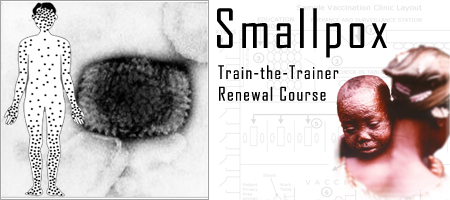
  • Smallpox Train-the-Trainer Renewal

    Smallpox Train-the-Trainer Renewal

    The purpose of this course is to provide public health officials with information regarding smallpox to be able to respond quickly and effectively to smallpox outbreaks and in case smallpox is used as a bioterrorism weapon.

    There are ten modules in this course:

    1. Smallpox: The Disease
    2. Rash Evaluation 
    3. Distribution & Storage 
    4. Reconstitution of Vaccine
    5. Vaccination Clinic Set Up
    6. Administering Vaccine 
    7. Screening 
    8. Site Care/Take Evaluation 
    9. Adverse Reactions 
    10. Quarantine & Isolation

    Intended Audience

    Those who have successfully completed an Iowa Department of Public Health Smallpox TTT program with updated information and an opportunity to review the subject content.

    Learning Objectives

    At the end of this course, the learner will have the basic knowledge required to:

    • Recognize signs and symptoms of smallpox.
    • Evaluate rash illness; use CDC protocol when evaluating rash illness.
    • Describe how smallpox vaccine will be distributed; maintain the “cold chain” when shipping and storing vaccine.
    • Reconstitute smallpox vaccine.
    • Describe critical stations and tasks in a smallpox vaccination clinic; plan or assist in planning the layout and staffing of a clinic.
    • Administer smallpox vaccine.
    • Screen potential vaccines and household contacts for contraindications of smallpox vaccine.
    • Educate vaccines on site care.
    • Identify a major reaction to smallpox vaccine; distinguish between a “take” and “non-take”.
    • Identify adverse events in smallpox vaccine recipients; identify appropriate treatment options; use the correct procedure for reporting adverse events.
    • Use quarantine and isolation, as well as new legal tools enacted in 2003 for public health disasters, to contain smallpox disease.

    Pre-requisites/Learning Level

    None

    Competencies addressed

    Competencies identified:

    • 1.1 Solve problems under emergency conditions.

      • 1.1.1 Recognize emergency conditions and the resulting problems.
      • 1.1.3 Prioritize problems based on level of hazard and degree of risk.
      • 1.1.8 Assess information, resources and procedures necessary to address the problems in emergency situations.
      • 1.1.11 Assume responsibility for taking specific actions that further organizational mission or population health in the presence of a public health emergency.
      • 1.1.13 Maintain awareness of one’s own tolerance for risk.
    • 1.3 Facilitate collaboration with internal and external emergency response partners.

      • 1.3.3 Develop collaborative emergency response plans and/or policies with appropriate internal and external emergency response partners. 
      • 1.3.5 Maintain agreements (e.g., Mutual Aid Agreements or MAAs, Emergency Management Assistance Compacts or EMACs, Memoranda of Understanding or MOUs) with external emergency response partners to secure and provide assistance and resources in all phases of emergency preparedness and response.
    • 1.4 Maintain situational awareness.

      • 1.4.2 Analyze information regarding the status, attributes, and dynamics of relevant factors impacting response activities.
      • 1.4.5 Classify key resources used in problem solving for specific types of incidents and the immediate needs of victims.
      • 1.4.13 Develop strategies to minimize distracters impacting situational awareness.
    • 1.6 Act within the scope of one’s legal authority.

      • 1.6.2 Apply appropriate public health authority to minimize adverse outcomes (e.g., persons, property, etc.).
      • 1.6.3 Access the emergency preparedness and response policies and procedures of one’s own organization.
      • 1.6.4 Respond legally and consistently within the values and mission of one’s public health organization.
      • 1.6.5 Document appropriate information relative to the application of the law.
    • 2.1 Manage information related to an emergency.

      • 2.1.1 Interpret procedures in emergency operations plan related to information management.
    • 2.3 Report information potentially relevant to the identification and control of an emergency through the chain of command.  

      • 2.3.2 Communicate within the organization’s defined command structure (i.e. report up, communicate down).
      • 2.3.3 Assess relevant emergency situational information coming into the agency. 
      • 2.3.4 Alert appropriate staff to unusual events based on identified trigger points and/or thresholds as outlined in the Communications Annex.
    • 2.5 Manage the recording and/or transcription of data according to protocol.

      • 2.5.1 Adhere to relevant ethics guidelines, state, and federal laws regarding data collection, management, and dissemination.
    • 3.3 Participate in improving the organization’s capacities (including, but not limited to programs, plans, policies, laws and workforce training).

      • 3.3.2 Describe the key role of public health workers in an emergency response.
      • 3.3.4 Apply knowledge and skills gained through participation in emergency preparedness and response activities to improve organizational capacities.
      • 3.3.5 Apply organizational policies and plans during an emergency response.
    • 4.2 Employ protective behaviors according to changing conditions, personal limitations, and threats

      • 4.2.1 Discuss the need to protect worker health and safety in emergencies and disasters.
      • 4.2.3 Promote taking protective actions in response to current and changing threats.

    CEUs Offered

    None

    Cost

    Free

    Modality/format

    Online Self-Pace

    Length

    1 hour

    Presenter(s) and/or Content Experts

    Technical requirements

    • Adobe Acrobat Reader 
    • Flash Player 
    • Speakers

    Registration requirements

    Register a free account

    Creation and/or update

    February 13, 2013

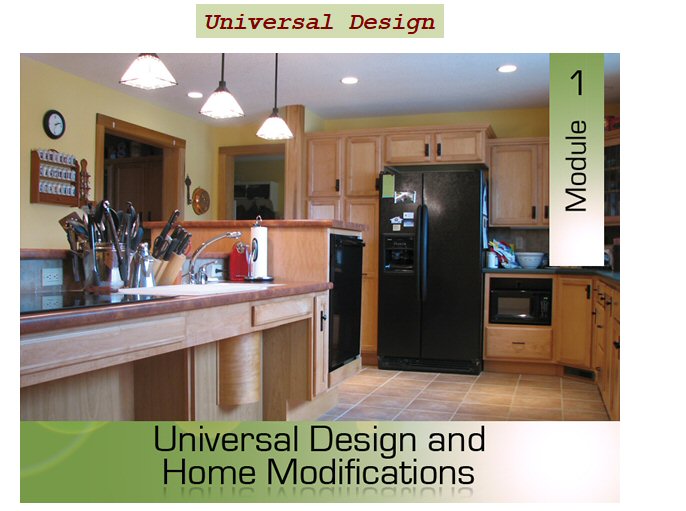
  • Universal Design – Module 1: Universal Design and Home Modifications

    Universal Design – Module 1: Universal Design and Home Modifications

    Course Summary

    There are eight sections in this course:

    • Section 1:How Are We Changing
    • Section 2:The ADA and Building Codes
    • Section 3:Universal Design and Home Modifications
    • Section 4:Determining a Strategy for Implementation
    • Section 5:Additional Resources
    • Section 6:Funding/Financial Information
    • Section 7:Project Opportunities
    • Section 8:Design Scenarios

    There are review questions at the end of Sections 1 through 4. These review questions will provide you with an opportunity to apply the knowledge and skills presented in these sections. There is a post-test at the end of the course.

    For a full description of requirements for receiving a Certificate of Completion, please go to the “Certificate of Completion Information” page.

    Intended Audience

    professional home builders, remodelling contractors, and related building trades

    Learning Objectives:

    After completing this module, participants will be able to:

    • Discussthe changing demographics and implications on the built environment
    • Discussthe ADA standards that might be applicable in the design and construction of a residential setting
    • Reviewexamples of Universal Design concepts in a residential setting
    • Reviewsite consideration
    • Provideproduct, materials, design solutions and resources
    • Provideinformation regarding funding opportunities
    • Provideinformation of possible sources of project work and referral opportunities

    Pre-requisites/Learning Level

    No pre-requisites

    Competencies addressed

    Core Competencies for Public Health Professionals identified:

    Domain 4: Cultural Competency Skills

    • 4A3. Describes the ways diversity may influence policies, programs, services, and the health of a community
    • 4A5. Addresses the diversity of individuals and populations when implementing policies, programs, and services that affect the health of a community

    CEUs Offered

    None

    Cost

    Free

    Modality/format

    Online Self-Pace

    Length

    3 hours

    Presenter(s) and/or Content Experts

    Kelly Dinges

    Technical requirements:

    • Adobe Acrobat Reader 
    • Flash Player 
    • Speakers

    Registration requirements

    Register a free account

    Creation and/or update

    March 29, 2013

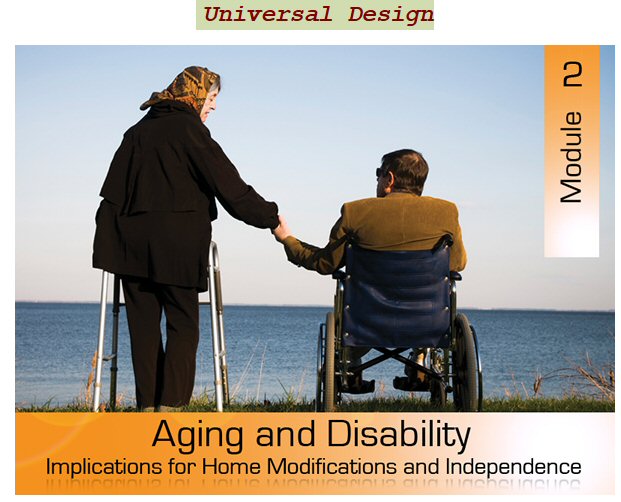
  • Universal Design – Module 2: Aging and Disability – Implications for Home Modifications and Independence

    Universal Design – Module 2: Aging and Disability – Implications for Home Modifications and Independence

    Course Summary

    There are six sections in this course:

    • Section 1:How are we Changing?
    • Section 2:The ADA, Building Codes
    • Section 3:Home Modification Ideas
    • Section 4:Determining a Strategy for Implementation
    • Section 5:Additional Resources
    • Section 6:Funding/Financial Information

    There are review questions at the end of section 1 to 4. These review questions will provide you with an opportunity to apply the knowledge and skills presented in these sections. There is a post-test at the end of the course.

    For a full description of requirements for receiving a Certificate of Completion, please go to the “Certificate of Completion” page.

    Intended Audience

    professional home builders, remodelling contractors, and related building trades

    Learning Objectives:

    After completing this module, participants will be able to:

    • Discussthe changing demographics and implications on the built environment, especially for senior and people with disabilities
    • Discussthe specific trends regarding institutional, home, and community based services
    • Reviewexamples of Universal Design and home modification ideas
    • Discusssite conditions
    • Provideproduct and resources information
    • Providefunding and financial information

    Pre-requisites/Learning Level

    No pre-requisites

    Competencies addressed

    Core Competencies for Public Health Professionals identified:

    Domain 4: Cultural Competency Skills

    • 4A3. Describes the ways diversity may influence policies, programs, services, and the health of a community
    • 4A5. Addresses the diversity of individuals and populations when implementing policies, programs, and services that affect the health of a community

    CEUs Offered

    None

    Cost

    Free

    Modality/format

    Online Self-Pace

    Length

    3 hours

    Presenter(s) and/or Content Experts

    Kelly Dinges

    Technical requirements:

    • Adobe Acrobat Reader 
    • Flash Player 
    • Speakers

    Registration requirements

    Register a free account

    Creation and/or update

    April 11, 2013

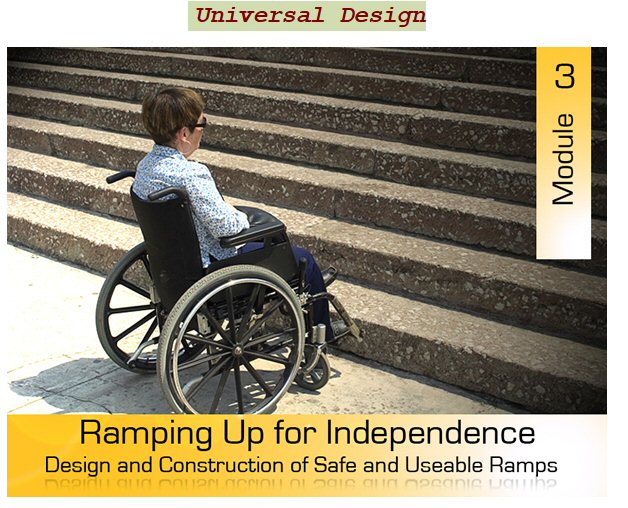
  • Universal Design – Module 3: Ramping Up For Independence – Design and Construction of Safe and Useable Ramps

    Universal Design – Module 3: Ramping Up For Independence – Design and Construction of Safe and Useable Ramps

    Goal

    This course is designed for individual consumers and other parties interested in providing safe and useable ramps.

    The goals for this course include:

    • Increase awareness of ramp design and construction

    Intended Audience

    The intended audience for this course will include individual consumers, family members, building trades programs and volunteer organizations.

    Length

    The length of time for participants to take this course is estimated to be 1 1/2 to 2 hours.

    Course Content

    There are nine sections in this course:

    Section 1: How Are We Changing?
    Section 2: The ADA and Building Codes
    Section 3: Site Considerations

    Section 4: Types of Ramps
    Section 5: Construction Tips
    Section 6: Products and Resources
    Section 7: Iowa Contractor Network
    Section 8: Funding/Financial Information
    Section 9: Ramp Designs 

    There are review questions at the end of section 1 to 5. These review questions will provide you with an opportunity to apply the knowledge and skills presented in these sections. There is a post-test at the end of the course. 

    For a full description of requirements for receiving a Certificate of Completion, please go to the “Certificate of Completion” page.

    Acknowledgement

    The following organizations collaborate on the development of this course: Iowa Department of Public Health (IDPH), Living Well Iowa at the Center for Disabilities and Development, Iowa Program for Assistive Technology, Midwest Accessibility Initiative, the Upper Midwest Public Health Training Center (UMPHTC), and Institute for Public Health Practice (IPHP) UI College of Public Health.

    Funding for this project has been provided by the Centers for Disease Control and Prevention.

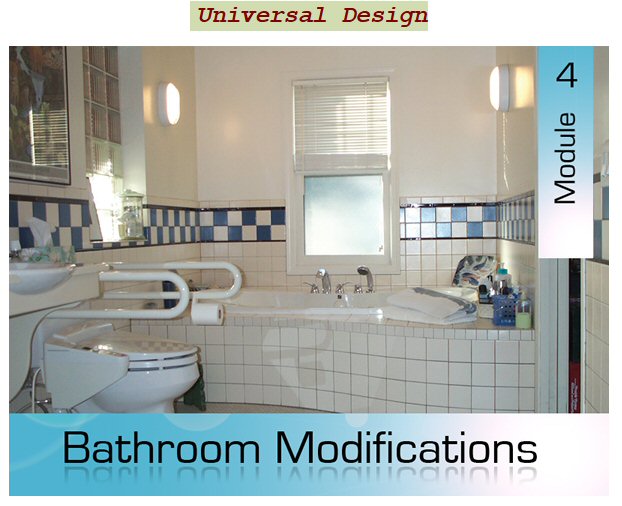
  • Universal Design – Module 4: Bathroom Modifications

    Universal Design – Module 4: Bathroom Modifications

    Course Summary

    There are six sections in this course:

    • Section 1:How are we Changing?
    • Section 2:The ADA, Building Codes
    • Section 3:Home Modification Ideas
    • Section 4:Determining a Strategy for Implementation
    • Section 5:Additional Resources
    • Section 6:Funding/Financial Information

    There are review questions at the end of section 1 to 3. These review questions will provide you with an opportunity to apply the knowledge and skills presented in these sections. There is a post-test at the end of the course.

    For a full description of requirements for receiving a Certificate of Completion, please go to the “Certificate of Completion” page.

    Intended Audience

    individual consumers, family members, remodeling contractors and service providers

    Learning Objectives:

    After completing this module, participants will be able to:

    • Discussthe changing demographics and implications on the built environment
    • Discussthe ADA standards and how they might be applied in the design, construction and/or remodel of a residential bathroom
    • Discussthe importance of a client goals for independence
    • Reviewexamples of bathroom modification ideas
    • Provideinformation regarding product and resources

    Pre-requisites/Learning Level

    No pre-requisites

    Competencies addressed

    Core Competencies for Public Health Professionals identified:

    Domain 2: Policy Development/Program Planning Skills

    • 2A10. Gathers information for evaluating policies, programs, and services (e.g., outputs, outcomes, processes, procedures, return on investment)

    Domain 4: Cultural Competency Skills

    • 4A3. Describes the ways diversity may influence policies, programs, services, and the health of a community
    • 4A5. Addresses the diversity of individuals and populations when implementing policies, programs, and services that affect the health of a community

    Domain 7: Financial Planning and Management Skills

    • 7A5. Contributes to development of program budgets
    • 7A6. Provides information for proposals for funding (e.g., foundations, government agencies, corporations)

    CEUs Offered

    None

    Cost

    Free

    Modality/format

    Online Self-Pace

    Length

    2 hours

    Presenter(s) and/or Content Experts

    Kelly Dinges

    Technical requirements:

    • Adobe Acrobat Reader 
    • Flash Player 
    • Speakers

    Registration requirements

    Register a free account

    Creation and/or update

    April 24, 2013

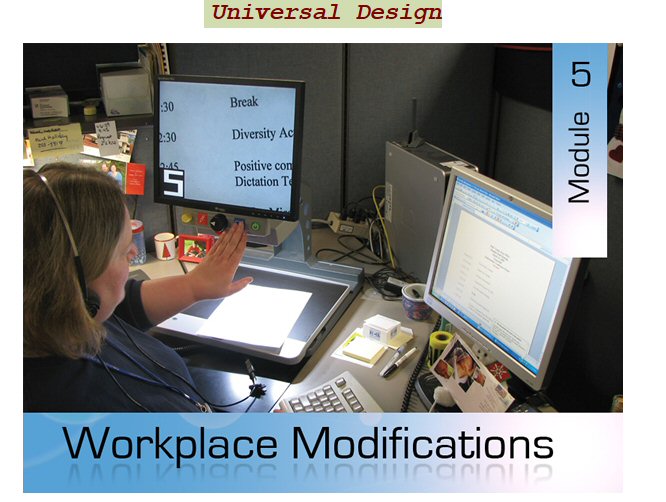
  • Universal Design – Module 5: Workplace Modifications

    Universal Design – Module 5: Workplace Modifications

    Course Summary

    There are six sections in this course:

    • Section 1: Today’s Workforce and Beyond
    • Section 2: ADA Accessibility Information
    • Section 3: Master Planning for Accessibility
    • Section 4: Accommodating Specific Employee Needs
    • Section 5: Tax Provisions for Improving Accessibility
    • Section 6: Products and Resources

    There are review questions at the end of section 1 to 4. These review questions will provide you with an opportunity to apply the knowledge and skills presented in these sections. There is a post-test at the end of the course.

    For a full description of requirements for receiving a Certificate of Completion, please go to the “Certificate of Completion” page.

    Intended Audience

    This course is designed for individual employees and employers interested in accessible work environments.

    Learning Objectives:

    After completing this module, participants will be able to:

    • Discussthe changing demographics and implications in the work environment, especially for seniors and people with disabilities
    • Discussthe Americans with Disabilities Act Accessibility Guidelines and general compliance
    • Discussthe workplace modifications for employee specific situations
    • Discussthe site considerations such as parking, accessible routes and restrooms
    • Provide information regarding tax incentives for modifications and compliance
    • Provideinformation regarding products, materials, and resources

    Pre-requisites/Learning Level

    No pre-requisites

    Competencies addressed

    Core Competencies for Public Health Professionals identified

    Domain 2: Policy Development/Program Planning Skills

    • 2A8. Implements policies, programs, and services
    • 2A10. Gathers information for evaluating policies, programs, and services (e.g., outputs, outcomes, processes, procedures, return on investment)

    Domain 4: Cultural Competency Skills

    • 4A3. Describes the ways diversity may influence polices, programs, services, and the health of a community
    • 4A5. Addresses the diversity of individuals and populations when implementing policies, programs, and services that affect the health of a community

    CEUs Offered

    None

    Cost

    Free

    Modality/format

    Online Self-Pace

    Length

    1 hour

    Presenter(s) and/or Content Experts

    Kelly Dinges

    Technical requirements:

    • Adobe Acrobat Reader 
    • Flash Player 
    • Speakers

    Registration requirements

    Register a free account

    Creation and/or update

    May 1, 2013

  • Finding & Evaluating Health Information on the Internet

    Finding & Evaluating Health Information on the Internet

    There are three sections in this course:

    • Section 1: Evaluating Health Information on the Internet
    • Section 2: Utilizing Databases for Finding Health Information on the Internet
    • Section 3: Education and Training Opportunities

    There are review questions at the end of each part. These review questions will provide you with an opportunity to apply the knowledge and skills presented in these parts. For a full description of requirements for receiving a Certificate of Completion, please go to the Certificate of Completion page.

    Intended Audience

    public health administrators and nurse administrators who are relatively new in their positions (3 years or less) and who seek to enhance their skills and knowledge.

    Learning Objectives:

    After completing this course, participants will be able to:

    Evaluatehealth information on the internet using standard criteria

    Explainhow to enhance searching in electronic resources

    Locatepublic health information resources on the Internet

    Identifyregional and national public health training opportunities

    Pre-requisites/Learning Level

    No pre-requisites

    Competencies addressed

    Core Competencies for Public Health Professionals identified

    Domain 1: Analytical/Assessment Skills

    • 1A1. Identifies the health status of populations and their related determinants of health and illness (e.g. factors contributing to health promotion and disease prevention; the quality, availability, access to, and use of health services)
    • 1A4. Uses methods and instruments for collecting valid and reliable quantitative and qualitative data
    • 1A5. Identifies sources of public health data and information
    • 1A11. Uses information technology to collect, store, and retrieve data

    Domain 3: Communication Skills

    • 3A3. Identifies the health literacy of populations served (e.g. language, attitudes, beliefs, access to health information)

    CEUs Offered

    None

    Cost

    Free

    Modality/format

    Online Self-Pace

    Length

    1 hour

    Presenter(s) and/or Content Experts

    Christopher Childs, MS

    Technical requirements:

    • Adobe Acrobat Reader 
    • Flash Player 
    • Speakers

    Registration requirements

    Register a free account

    Creation and/or update

    May 21, 2013