Course Type: Course

  • Prescription and Over the Counter Drugs: Supporting Patients with Evidence Based Information

    Prescription and Over the Counter Drugs: Supporting Patients with Evidence Based Information

    This course is designed to demonstrate how resources for the
    National Library of Medicine can be used to help the public health and
    healthcare community find free information on prescription and Over-the-counter (OTC) drugs.

    Intended Audience

    Medical professionals, public health workers, first
    responders, students, and librarians looking to assist the public health and healthcare community find free information on prescription and OTC drugs.

    Learning objectives

    At the end of this training module, you will be able to:

    • Describe some
      current challenges related to prescription and OTC drug use in the USA using
      authoritative statistical sources.
    • Find information
      about safety and adverse effects of common drugs and chemicals in lactating
      mothers using LactMed.
    • Retrieve FDA prescription drug labels using DailyMed.

    Pre-requisites/Learning Level

    No pre-requisites

    Competencies addressed

    Core Competencies for Public Health Professionals

    Domain 6: Public Health Science Skills
    • 6B5. Retrieves evidence (e.g.,
      research findings, case reports, community surveys) from print and electronic
      sources (e.g., PubMed, Journal of Public Health Management and Practice,
      Morbidity and Mortality Weekly Report, The World Health Report)
      to support decision making.

    Cost

    Free

    Modality/format

    Online Self-Pace

    Length

    1 hour

    Presenter(s) and/or Content Experts

    Nora Barnett, Outreach Specialist and Derek Johnson, MLIS, Associate Director

    Network of the National Library of Medicine

    Greater Midwest Region

    Technical requirements

    • Adobe Acrobat Reader 
    • Speakers

    Registration requirements

    Register a free account

    Creation and/or update

    Released February 2021

  • Changing Talk: Online (CHATO)

    Changing Talk: Online (CHATO)

    Goal

    The goal of this communication course is to increase awareness of the importance of effective communication with older adults and to use effective communication between staff and residents in nursing homes and other health care settings.

    Intended Audience

    The intended audience for this course is staff at nursing home facilities, independent and assistive living, and health care settings in the community that include registered nurses, nursing assistants, nursing home dieticians, direct care professionals, other administrations and support employees.

    Length

    The total program is approximately three hours and 15 minutes, split into three modules and the evaluation. Each module is approximately an hour, depending on the individual user. The evaluation is approximately 15 minutes. Upon completion of all three modules, the evaluation, and 70 percent on a posttest, a certificate of completion (three nursing contact hours) will be awarded.

    Content

    There are three modules in this course:

    • Module 1
      • This course contains information on the importance, benefits, and components of effective communication.
    • Module 2
      • This course contains information on some communication barriers and challenges, and effective and ineffective communication strategies.
    • Module 3
      • This course contains information on common problems during communication, guidelines for improving communication, and some characteristics of affirming communication.

    Learning Objectives

    After completing the CHATO program, participants will:

    1. Identify the importance of communication in nursing care of older adults.

    2. Identify barriers to communication in care of older adults.

    3. Distinguish effective and ineffective communication strategies.

    4. Identify elderspeak and its negative effects.

    5. Revise communication to reduce elderspeak and increase person-centered messages.

    Module 1

    Upon completion of this module, you will be able to:

    • Recognize the importance of communication to older adults.
    • Identify barriers to communication in care of older adults.
    • Distinguish between effective and ineffective communication strategies.
    Module 2

    Upon completion of this module, you will be able to:

    • Identify elderspeak and its potential negative messages.
    • Contrast effective and ineffective communication strategies.
    • Revise transcripts to reduce elderspeak and ineffective communication.
    Module 3

    Upon completion of this module, you will be able to:

    • Identify affirming communication. 
    • Critique communication in video recordings of nursing home staff-resident communication.
    • Rewrite transcripts to reduce elderspeak and ineffective communication. 

    The course content was presented by Dr. Kristine Williams (Dr. Williams’ Bio). There are learning activities, discussion forums, list of resources, posttest, and evaluations at the end of the course. The practice activities were designed to provide you with opportunities to apply the knowledge and skills presented in the course. Please take part in the discussion forum to share your experience and reflect on others.

    A Certificate of Completion is awarded on successful completion of this course. In order to successfully complete this course, you MUST: Score 70% or higher on the posttest. If you do not receive 70% on the posttest, you may review the material and re-take it.

    Approval Statement

    This continuing nursing professional development activity was approved by the Midwest Multistate Division, an accredited approver by the American Nurses Credentialing Center’s Commission on Accreditation. 

    Participant receives 3 contact hours for completing CHATO.

    Acknowledgements

    This work was supported by the National Institute of Nursing Research of the National Institutes of Health under Award Number R01NR011455, Changing Talk to Reduce Resistiveness to Dementia Care, K. Williams, PI. The content is solely the responsibility of the authors and does not necessarily represent the official views of the National Institutes of Health.

    We appreciate the expertise of The University of Iowa College of Nursing, and the Midwestern Public Health Training Center, University of Iowa College of Public Health (MPHTC–UICPH) for their help in converting the CHAT content into an interactive online format.

    Image/Video Credits:

    • Thinkstock
    • Lost for Words – Masterpiece Theater
    • Elizabeth Layton for “The Motherless Child” artwork/drawings – permission granted from Center on Aging, University of Kansas Medical Center.
    • Classroom teaching elderspeak cartoon by Tony Husband – permission granted from cartoons@tonyhusband.co.uk

    Special Thanks to the Nursing Home residents and staff who participated in video recordings and to Ruth Herman and Mary Suggs who participated as actresses.

    Conflict of Interest

    The planners and presenters have no conflicts of interest to declare.

      KansasLogo.png  

    Midwest MSD Approval Number:  KS523‐1376
    Contact hours for this program will not be awarded after May 15, 2023

  • Direct Care Core Curriculum (until July 1, 2026)

    Direct Care Core Curriculum (until July 1, 2026)

    This is the Program (series of courses) that contains the 6 Core Unit courses that make up the Core Curriculum Training for Direct Care Providers.

  • Biosecurity for Clinical Laboratories

    Biosecurity for Clinical Laboratories

    There are several sections in this course:

    1. Biosecurity and Biosafety
    2. Risk Assessments and the AMP Model
    3. AMP: Assessment
    4. AMP: Mitigation
    5. AMP: Performance
    6. Developing a Biosecurity Plan
    7. Quiz

    This course includes several interactions designed to underscore concepts discussed in the course, two downloadable risk assessment templates and laboratory guidance from APHL on specimen storage.

    Intended Audience

    This course is for clinical laboratorians who want to improve their knowledge of biosecurity practices that protect against unauthorized access, loss, theft, misuse, diversion or intentional release of dangerous biological materials.

    Learning Objectives

    At the end of the training module, you will be able to:

    • Describe the relationship between biosafety and biosecurity
    • List outcomes of a successful biosecurity risk assessment
    • Identify types of controls used to manage biosecurity risk
    • Perform a biosecurity assessment
    • Develop a biosecurity plan

    Pre-requisites/Learning Level

    No prerequisites

    Competencies addressed

    N/A

    CEUs Offered

    TBD

    Cost

    Free

    Modality/Format

    Online self-pace

    Length

    30 minutes

    Presenter(s) and/or Content Experts

    Dr. Michael Pentella; Wanda Reiter Kintz, Ph.D.; Drew C. Fayram, MS

    Technical requirements

    1. Adobe Acrobat Reader (free download)
    2. Speakers or headphones

    Registration Requirements

    Register a free account

    Creation and/or update

    Released February 2018

  • Dental Health Education for Community Health Workers

    Dental Health Education for Community Health Workers

    There are eight brief modules in this course:

    1. Structure and function of the oral cavity
    2. Tooth eruption
    3. Diseases and condition of the oral cavity
    4. Oral health promotion and prevention
    5. Fluoride, pits and fissure sealants
    6. Oral health and systemic diseases, oral health and smoking
    7. Oral health in pregnancy, children, older adults and special populations
    8. Oral health services and resources in Iowa

    Each module has specific objectives and a brief assessment. The assessments will provide you with an opportunity to apply the knowledge and skills presented in each module. Those completing each module and assessment successfully (average scores 75% or above) will earn a certificate of competence in basic oral health knowledge.

    Intended Audience

    The intended audience for this course is community health workers and other front-line workers that have client or patient-facing roles.

    Learning Objectives

    Provided within each module

    Pre-requisites/Learning Level

    No pre-requisites

    Competencies Addressed

    This training provides overview information necessary to acquire basic knowledge of oral health within the general and specific populations; the systemic connection to overall health; prevention and available safety net services and resources in Iowa.

    CEUs Offered

    None

    Cost

    Free

    Modality/format

    Online Self-Pace

    Length

    Approximately 1.5 hours

    Presenter(s) and/or Content Experts

    Dr. Olayinka Adekugbe
    Mary Kelly

    Technical requirements:

    • Adobe Acrobat Reader
    • Speakers or headphones

    Registration requirements

    Register a free account

    Creation and/or update

    May 2021

  • Electronic Death Registration System: Medical Examiner/Medical Examiner Investigator EMER

    Electronic Death Registration System: Medical Examiner/Medical Examiner Investigator EMER

    Course Goal

    This course is designed to help Medical Examiners (ME) and Medical Examiner Investigators (MEI), and staff better understand what the Electronic Medical Examiner Reporting (EMER) is and become familiar with the system.

    Intended Audience

    New and experienced ME, MEI, and staff

    Learning objectives

    After completing this training, you should be able to:

    • Identify the Iowa Electronic Death Registration System (EDRS) and how to use it
    • Demonstrate how to complete a death certificate
    • Identify what needs to be completed for EMER
    • Distinguish what the guidelines are for medical examiner cases
    • Review how to document drug deaths
    • Identify what an ill-defined cause of death is and how to better document cause of death
    • Complete death record by avoiding “pending” or “unknowns” on death records
    • Recognize the importance of entering data in a timely and accurate manner
    • Identify where to find additional information about cause of death reporting

    Pre-requisites/Learning Level

    No pre-requisites

    Cost

    Free

    Modality/format

    Online Self-Pace

    Length

    1 hour

    Technical requirements

    • Adobe  Acrobat Reader
    • Headphones and/or Speakers for listening to audio

    Steps to Complete This Training

    The course includes : Course Overview, Course Module, Post-Test, Course Evaluation, and a Certificate of Completion at the end of this course. You must review the material in the course module and complete the post-test. A Certificate of Completion is awarded on
    successful completion of this course. In order to successfully complete this course, you 
    MUST score 70% or higher on the posttest. If you do not receive 70% on the posttest, you may review the material and re-take it.

    Core Competencies Addressed

    Domain 1: Analytical/Assessment Skills

    1A2: Identifies quantitative and qualitative data and information (e.g., vital statistics, electronic health records, transportation patterns, unemployment rates, community input, health equity impact assessments) that can be used for assessing the health
    of a community.

    1B2: Determines quantitative and qualitative data and information (e.g., vital statistics, electronic health records, transportation patterns, unemployment rates, community input, health equity impact assessments) needed for assessing the health of a
    community.

    Technical and Content Experts

    Terri Barnes, User Senior Business
    Analyst, Iowa Office of the State Medical Examiner, Bureau of Health Statistics, Iowa Department of Public Health

    Jennifer Caskey, Death Registration Program Manager, Iowa Office of the State Medical Examiner, Bureau of Health Statistics, Iowa Department of Public Health

    Sandra Lyles, Field Representative, Bureau of Health Statistics, Iowa Department of Public Health

    Acknowledgments

    This course was presented by the Bureau of Health Statistics and the Iowa Office of the State Medical Examiner at the Iowa Department of Public Health. 

    Iowa Department of Public Health Iowa Office of the State Medical Examiner

    Creation and/or Update

    August 2021

  • Cross-Cultural Communication and Nutrition Assessment

    Cross-Cultural Communication and Nutrition Assessment

    This course is designed for WIC personnel and other health care providers who complete nutrition assessments. Awareness of cross-cultural communication allows WIC personnel to create a more rich and enhanced assessment and counseling experiences with
    clients. The goals of the course are to:

    • Describe cross-cultural communication and why it is necessary in practice.
    • Provide examples of effective communication techniques when completing nutrition assessments.
    • Identify appropriate communication strategies when working with clients that have a language difference.

    Content

    There are three sections in this course:

    • Section 1: Cross-Cultural and Communication Techniques
    • Section 2: Communicating with Language Differences
    • Section 3: Scenarios and Game

    There are review questions at the end of section 1 and 2. These review questions will provide you with an opportunity to apply the knowledge and skills presented in these sections. In section 3, there are three scenarios that will allow you to apply the
    knowledge that you just learn. “The Effective Non-Verbal Communication” game is provided as a fun activity to enhance content retention. Finally, there is a posttest at the end of the course.

    Intended Audience

    WIC CPAs (competent professional authorities) who perform nutrition assessments for WIC participants. The course will provide overview information on cultural competence in relation to feeding and eating practices and is not intended to be inclusive of
    all information needed. Some contents may also applicable to health care providers and public health professionals who are communicating with clients from diverse background.

    Learning Objectives

    Section 1: Cross-Cultural and Communication Techniques

    After completing this section, participants will be able to:

    • Identify client demographics and their backgrounds.
    • Recognize the importance of cross-cultural communication.
    • Recognize how your culture and background may influence your communication skills during nutrition assessment.
    • Identify communication challenges when working with multicultural clients.
    • Identify ways to establish trust and build rapport with participants.
    • Apply effective communication techniques when completing nutrition assessment.

    Section 2: Communicating with Language Differences

    After completing this section, participants will be able to:

    • Describe the process of selecting and working with interpreters and language lines.
    • Identify the appropriate strategies when communicating with clients that have language differences.
    • Define low literacy and health literacy.

    Section 3: Scenarios and Game

    After completing this section, participants will be able to:

    • Apply the practice of cultural sensitivity and critical thinking when completing nutrition assessment.

    Pre-requisites/Learning Level

    No Pre-requisites

    Core Competencies for Public Health Professionals

    Domain 3: Communication Skills

    • 3A1. Identifies the literacy of populations served (e.g., ability to obtain, interpret, and use health and other information; social media literacy)
    • 3A2. Communicates in writing and orally with linguistic and cultural proficiency (e.g., using age-appropriate materials, incorporating images)

    Domain 4: Cultural Competency Skills

    • 4A3. Describes the ways diversity may influence policies, programs, services, and the health of a community
    • 4A5. Addresses the diversity of individuals and populations when implementing policies, programs, and services that affect the health of a community

    Certificate of Completion

    A certificate of completion is awarded on successful completion of this course. In order to successfully complete this course, you MUST score 70% or higher on the Posttest.

    If you do not receive 70% on the posttest, you may review the material and re-take it. The posttest will become available for a re-take 2 business days after your first attempt.


    Contact Hours/CEUs Offered

    This course no longer provides continuing education by the Iowa Board of Nursing and the Commission on Dietetic Registration

    Cost

    Free

    Modality/format

    Online Self-Pace

    Length

    2 hours

    Presenter(s) and/or Content Experts Planning Course Committee Members

    Nor Hashidah Abd-Hamid, PhD; Urmil Aggarwall, MS, RD, LD; Brenda Dobson, MS, RD, LD; Dena Fife, MA; Pat Hildebrand, MS, RD, LD; Kim Staab, RN; Marilyn Alger, MSW; Janice Edmunds-Wells, MSW; Debra Kibbe, MS; Michele Devlin, DrPH; Mark Grey, PhD

    Technical Requirements

    • Adobe Acrobat Reader 
    • Flash Player 
    • Speakers

    Registration requirements

    Register a free account

    Acknowledgements

    The following organizations collaborated on the development of this course: United States Department of Agriculture (USDA), Food and Nutrition Service; Iowa Department of Public Health (IDPH)- Iowa WIC Program; University of Iowa College of Public Health
    Institute for Public Health Practice (UICPH-IPHP); and Region 7 Midwestern Public Health Training Center (MPHTC).

    A special
    thanks also to our video dialogue models:
    Charles Dufano, Dena Fife, and Mary Klahn-Ramstad.

    This project is funded at least in part with Federal funds from the U.S. Department of Agriculture, Food and Nutrition Service.

    Course Redesign and Redevelopment (January 2019):

    Nor Hashidah Abd-Hamid, Instructional Design and Development

    Melissa Richlen, Audio and Video Production

    Brett Borden, Narrator

    Tim Beachy, LMS Coordinator

    Creation and/or update

    January 15, 2019


  • Module 1: Diabetes: The Basic Questions and Answers

    Module 1: Diabetes: The Basic Questions and Answers

    Prevention and Management of Diabetes:  Current Community-Based Strategies


    Keywords

    Diabetes, Diabetes Prevention, Diabetes Management, Diabetes Prevention Program, Community-Based Agencies, Social Determinants of Health

    Descriptions

    This series will include five online modules which provide learners a comprehensive, awareness-level understanding of diabetes, to enable them to effectively support, advise, and monitor programs, and services provided through community-based agencies, including Federally-Qualified Health Centers (FQHCs).  This series includes five training modules with each has their own set of pre and posttest questions.

    • Module 1 – Diabetes: The Basic Questions and Answers
    • Module 2 – A Closer Look at Diabetes
    • Module 3 – Social Determinants of Health and Diabetes
    • Module 4 – Prediabetes: The Crisis We can Prevent
    • Module 5 – Improving Diabetes Care and Outcomes

    Learners will have flexibility to take the modules in whatever sequence they want, but the above sequence is recommended. Throughout the modules, learners will be introduced with fictional characters that may or may not have diabetes.

    Type of Training

    Online Self-Paced

    Intended Audience

    The intended audience for this course is anyone who would like to increase their knowledge of diabetes and diabetes prevention and control.

    Length of Training

    30 to 45 minutes for each module

    Learning Objectives

    At the end of each module, learners will be able to:

    Module 1

    • Identify specific data related to diabetes in the United States
    • Identify who is at risk for diabetes
    • Explain the economic and human cost of diabetes
    • Analyze the overall impact diabetes has in the United States

    Core Competencies for Public Health Professionals

    Domain: Public Health Science Skills – Tier 1

    6A6: Describes evidence used in developing, implementing, evaluating, and improving policies, programs, and services

    6A8: Contributes to the public health evidence base (e.g., participating in Public Health Practice-Based Research Networks, community-based participatory research, and academic health departments; authoring articles; making data available to researchers)

    Domain: Leadership and Systems Thinking Skills – Tier 1

    8A3: Describes the ways public health, health care, and other organizations can work together or individually to impact the health of a community

    8A4: Contributes to development of a vision for a healthy community (e.g., emphasis on prevention, health equity for all, excellence and innovation)

    Pre-requisites (Learning level)

    None

    CEUS Offered

    None

    Certificate of Completion

    Certificate of Completion for each module will be awarded on successful completion of this module which is getting a score of 70% or higher on the posttest.

    Cost

    Free

    Technical Requirements

    In order to successfully view the module in this series, please note the following requirements.

    • Windows computer/laptop: 
      • Any modern, updated browser (i.e. Google Chrome, Firefox, Edge)
      • Mac computer/laptop: Safari 7 and later, Google Chrome (latest version)
      • Apple iOS: Safari in Apple iOS 7 and later
      • Android OS: Google Chrome (latest version) in Android OS 4.1 and later
      • Screen Reader: JAWS 16 or later with Internet Explorer 11 or later
      • Speaker or headphone – the modules have audio

    Acknowledgements

    The following organizations collaborated on the development of this course: Health Resources & Service Administration (HRSA), Region 7 Midwestern Public Health Training Center (MPHTC); and the University of Iowa College of Public Health Institute for Public Health Practice (UICPH-IPHP).

    Course Design & Development

    Deputy Director, Strategic Partnerships Division, Office of Quality Improvement Bureau of Primary Health Care, Health Resources and Services Administration: Julia Sheen-Aaron, MPH

    Subject Matter Experts: Shirley Orr, MHS, APRN, NEA-BC

    MPHTC Coordinator: Laurie Walkner, MA

    Instructional Designers and Storyline Developers: Dena Fife, MA and Nor Hashidah Abd Hamid, PhD

    Item Writer: Roger Hileman, MA

    Narrators: Melissa Richlen and Brett Borden

    Audio/Video Productions: Melissa Richlen, BA

    LMS Coordinator: Tim Beachy, BA

    Communication Specialist: Hannah Morrison Shultz, MA

    Creation Date: November 1st, 2019
  • Module 2: A Closer Look at Diabetes

    Module 2: A Closer Look at Diabetes

    Prevention and Management of Diabetes:  Current Community-Based Strategies


    Keywords

    Diabetes, Diabetes Prevention, Diabetes Management, Diabetes Prevention Program, Community-Based Agencies, Social Determinants of Health

    Descriptions

    This series will include five online modules which provide learners a comprehensive, awareness-level understanding of diabetes, to enable them to effectively support, advise, and monitor programs, and services provided through community-based agencies, including Federally-Qualified Health Centers (FQHCs).  This series includes five training modules with each has their own set of pre and posttest questions.

    • Module 1 – Diabetes: The Basic Questions and Answers
    • Module 2 – A Closer Look at Diabetes
    • Module 3 – Social Determinants of Health and Diabetes
    • Module 4 – Prediabetes: The Crisis We can Prevent
    • Module 5 – Improving Diabetes Care and Outcomes

    Learners will have flexibility to take the modules in whatever sequence they want, but the above sequence is recommended. Throughout the modules, learners will be introduced with fictional characters that may or may not have diabetes.

    Type of Training

    Online Self-Paced

    Intended Audience

    The intended audience for this course is anyone who would like to increase their knowledge of diabetes and diabetes prevention and control.

    Length of Training

    30 to 45 minutes for each module

    Learning Objectives

    At the end of each module, learners will be able to:

    Module 2

    • Discuss the causes, symptoms, risks, and management of Type 1 diabetes
    • Describe the causes, symptoms, risks, and management of Type 2 diabetes  
    • Describe the causes, symptoms, risks, and management of gestational diabetes  
    • Describe the causes, symptoms, risks, and management of prediabetes
    • Assess the symptoms and the management based on the scenario presented

    Core Competencies for Public Health Professionals

    Domain: Public Health Science Skills – Tier 1

    6A6: Describes evidence used in developing, implementing, evaluating, and improving policies, programs, and services

    6A8: Contributes to the public health evidence base (e.g., participating in Public Health Practice-Based Research Networks, community-based participatory research, and academic health departments; authoring articles; making data available to researchers)

    Domain: Leadership and Systems Thinking Skills – Tier 1

    8A3: Describes the ways public health, health care, and other organizations can work together or individually to impact the health of a community

    8A4: Contributes to development of a vision for a healthy community (e.g., emphasis on prevention, health equity for all, excellence and innovation)

    Pre-requisites (Learning level)

    None

    CEUS Offered

    None

    Certificate of Completion

    Certificate of Completion for each module will be awarded on successful completion of this module which is getting a score of 70% or higher on the posttest.

    Cost

    Free

    Technical Requirements

    In order to successfully view the module in this series, please note the following requirements.

    • Windows computer/laptop: 
      • Any modern, updated browser (i.e. Google Chrome, Firefox, Edge)
      • Mac computer/laptop: Safari 7 and later, Google Chrome (latest version)
      • Apple iOS: Safari in Apple iOS 7 and later
      • Android OS: Google Chrome (latest version) in Android OS 4.1 and later
      • Screen Reader: JAWS 16 or later with Internet Explorer 11 or later
      • Speaker or headphone – the modules have audio

    Acknowledgements

    The following organizations collaborated on the development of this course: Health Resources & Service Administration (HRSA), Region 7 Midwestern Public Health Training Center (MPHTC); and the University of Iowa College of Public Health Institute for Public Health Practice (UICPH-IPHP).

    Course Design & Development

    Deputy Director, Strategic Partnerships Division, Office of Quality Improvement Bureau of Primary Health Care, Health Resources and Services Administration: Julia Sheen-Aaron, MPH

    Subject Matter Experts: Shirley Orr, MHS, APRN, NEA-BC

    MPHTC Coordinator: Laurie Walkner, MA

    Instructional Designers and Storyline Developers: Dena Fife, MA and Nor Hashidah Abd Hamid, PhD

    Item Writer: Roger Hileman, MA

    Narrators: Melissa Richlen and Brett Borden

    Audio/Video Productions: Melissa Richlen, BA

    LMS Coordinator: Tim Beachy, BA

    Communication Specialist: Hannah Morrison Shultz, MA

    Creation Date: November 1st, 2019
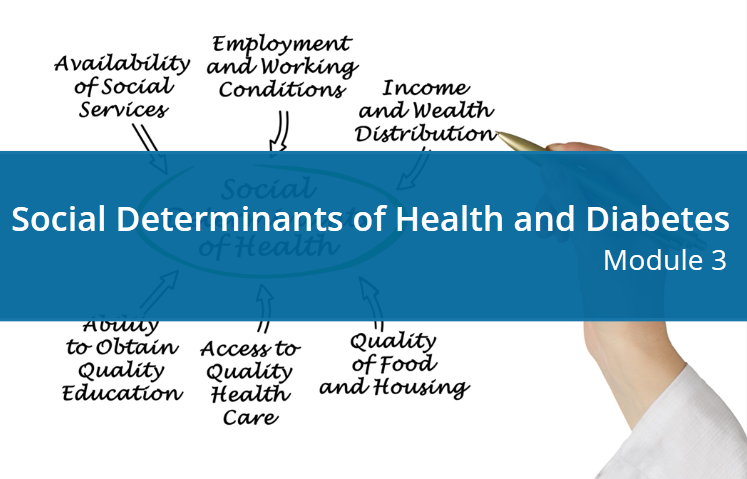
  • Module 3: Social Determinants of Health and Diabetes

    Module 3: Social Determinants of Health and Diabetes

    Prevention and Management of Diabetes:  Current Community-Based Strategies


    Keywords

    Diabetes, Diabetes Prevention, Diabetes Management, Diabetes Prevention Program, Community-Based Agencies, Social Determinants of Health

    Descriptions

    This series will include five online modules which provide learners a comprehensive, awareness-level understanding of diabetes, to enable them to effectively support, advise, and monitor programs, and services provided through community-based agencies, including Federally-Qualified Health Centers (FQHCs).  This series includes five training modules with each has their own set of pre and posttest questions.

    • Module 1 – Diabetes: The Basic Questions and Answers
    • Module 2 – A Closer Look at Diabetes
    • Module 3 – Social Determinants of Health and Diabetes
    • Module 4 – Prediabetes: The Crisis We can Prevent
    • Module 5 – Improving Diabetes Care and Outcomes

    Learners will have flexibility to take the modules in whatever sequence they want, but the above sequence is recommended. Throughout the modules, learners will be introduced with fictional characters that may or may not have diabetes.

    Type of Training

    Online Self-Paced

    Intended Audience

    The intended audience for this course is anyone who would like to increase their knowledge of diabetes and diabetes prevention and control.

    Length of Training

    30 to 45 minutes for each module

    Learning Objectives

    At the end of each module, learners will be able to:

    Module 3

    • Describe the social determinants of health that impact diabetes
    • Explain the factors that impact disease management and social determinants of health
    • Describe why lack of access to healthy options can influence healthy decision making
    • Discuss policy interventions which address social determinants contributing to diabetes

    Core Competencies for Public Health Professionals

    Domain: Public Health Science Skills – Tier 1

    6A6: Describes evidence used in developing, implementing, evaluating, and improving policies, programs, and services

    6A8: Contributes to the public health evidence base (e.g., participating in Public Health Practice-Based Research Networks, community-based participatory research, and academic health departments; authoring articles; making data available to researchers)

    Domain: Leadership and Systems Thinking Skills – Tier 1

    8A3: Describes the ways public health, health care, and other organizations can work together or individually to impact the health of a community

    8A4: Contributes to development of a vision for a healthy community (e.g., emphasis on prevention, health equity for all, excellence and innovation)

    Pre-requisites (Learning level)

    None

    CEUS Offered

    None

    Certificate of Completion

    Certificate of Completion for each module will be awarded on successful completion of this module which is getting a score of 70% or higher on the posttest.

    Cost

    Free

    Technical Requirements

    In order to successfully view the module in this series, please note the following requirements.

    • Windows computer/laptop: 
      • Any modern, updated browser (i.e. Google Chrome, Firefox, Edge)
      • Mac computer/laptop: Safari 7 and later, Google Chrome (latest version)
      • Apple iOS: Safari in Apple iOS 7 and later
      • Android OS: Google Chrome (latest version) in Android OS 4.1 and later
      • Screen Reader: JAWS 16 or later with Internet Explorer 11 or later
      • Speaker or headphone – the modules have audio

    Acknowledgements

    The following organizations collaborated on the development of this course: Health Resources & Service Administration (HRSA), Region 7 Midwestern Public Health Training Center (MPHTC); and the University of Iowa College of Public Health Institute for Public Health Practice (UICPH-IPHP).

    Course Design & Development

    Deputy Director, Strategic Partnerships Division, Office of Quality Improvement Bureau of Primary Health Care, Health Resources and Services Administration: Julia Sheen-Aaron, MPH

    Subject Matter Experts: Shirley Orr, MHS, APRN, NEA-BC

    MPHTC Coordinator: Laurie Walkner, MA

    Instructional Designers and Storyline Developers: Dena Fife, MA and Nor Hashidah Abd Hamid, PhD

    Item Writer: Roger Hileman, MA

    Narrators: Melissa Richlen and Brett Borden

    Audio/Video Productions: Melissa Richlen, BA

    LMS Coordinator: Tim Beachy, BA

    Communication Specialist: Hannah Morrison Shultz, MA

    Creation Date: November 1st, 2019