Course Type: Course

  • Ethics and Data Integrity for Non-Technical Staff

    Ethics and Data Integrity for Non-Technical Staff

    Course Summary

    This online course introduces the concepts of ethics and integrity, defines the difference between the two and illustrates how these traits apply to non-technical staff in a public health laboratory. Examples of general workplace ethics are used throughout the course, from arriving on time to using the Internet for non-work activities. the term, “data integrity” is introduced and its relationship to fraud is given, including Information Technology and Public Relations. The responsibilities of management and staff in maintaining data integrity and preventing fraud are presented in an interactive format. The importance of documentation, and its use as protection against the appearance of fraud, is stressed in this course. A brief overview of chain-of-custody protocols is also provided.

    Intended Audience

    staff in public health and other laboratories whose responsibilities lie outside of the (testing) laboratory area. This includes those in positions such as security, records, data entry, client services, supply services, Information Technlogy, QA, etc. Basic workplace ethics and personal integrity are important traits that warrant a comprehensive explanation and the occasional reminder. Data integrity, if not fully understood and maintained, can lead to the appearance of fraud or even to fraud itself, putting careers at risk.

    Learning Objectives:

    At the completion of this course, the participant will be able to:

    • Define the terms commonly associated with ethics, data integrity and chain of custody
    • Recognize staff’s responsibility to conduct themselves ethically in all facets of their workday
    • Describe role of staff in maintaining data integrity and chain of custody
    • Recognize the dangers and consequences of fraud and how to prevent it
    • State the responsibilities of management and staff in preventing fraud
    • List the steps and documentation necessary to maintain chain of custody
    • Discuss the importance of documentation in preventing fraud or the appearance of fraud

    Pre-requisites/Learning Level

    No pre-requisites

    Competencies addressed

    Leadership and Systems Thinking Skills, Communication Skills, Financial Planning and Management Skills

    CEUs Offered

    None

    Cost

    Free

    Modality/format

    Online Self-Pace

    Length

    1 hour

    Presenter(s) and/or Content Experts

    Marcia Valbracht BS, MHA,

    Technical requirements:

    • Adobe Acrobat Reader 
    • Flash Player 
    • Speakers

    Registration requirements

    Register a free account

    Creation and/or update

    December 31, 2014
  • Organizing Your Lab with Lean 6 Sigma Principles

    Organizing Your Lab with Lean 6 Sigma Principles

    Course Summary

    This
    online course explains the use of Lean 6S principles in organizing the physical
    workplace for efficiency. The course shows how to eliminate the four types of
    waste: mistakes & reworks, excess inventory, unnecessary transporting and
    unnecessary motion. To accomplish this, the six sequential steps of Lean 6S are
    explained in detail and illustrated with photographs as well as graphics.
    Examples of Lean 6S initiatives at the State Hygienic Laboratory in Iowa
    reinforce the results that can be accomplished by employing these principles.
    Additionally, the course includes several interactive sections to engage the
    user. This course provides a solid basis for anyone who is considering the use
    of Lean 6S principles in the workplace.

    Intended Audience

    Laboratory staff at all levels, from those in
    ancillary services to laboratory directors

    Learning Objectives

    After completion of this course, the
    participant will be able to:

    • • Identify 6S as a form of
      LEAN management. 
    • • Identify the steps/sequence
      of the 6S Process. 
    • • Recognize and discuss the
      four forms of waste addressed by 6S principles.
    • • Discuss the nature and
      importance of the planning process.
    • • State the primary purpose
      of each step in the process. 
    • • Describe key tools or
      methods used in each step.
    • • Identify benefits achieved
      through the 6S process.

    Pre-requisites/Learning Level

    No Pre-requisites

    Competencies addressed

    Policy Development/Program Planning Skills, Financial Planning and Management Skills

    CEUs Offered

    None

    Cost

    Free

    Modality/format

    Online Self-Pace

    Length

    1 hour

    Presenter(s) and/or Content
    Experts

    Lorelei Kurimski, MS

    Technical requirements

    • Adobe Acrobat Reader 
    • Flash Player 
    • Speakers

    Registration requirements

    Register a free account

    Creation and/or update

    January 6, 2015

  • Evaluating Effectiveness in Public Health at the Individual and Organizational Level

    This presentation will highlight the importance of a systematic approach in evaluating the effectiveness of public health programs, practices, and policies. The presentation will provide applied examples of key concepts and principles and emphasize practical
    approaches for developing and implementing these evaluation efforts.

    Intended Audience

    Learning Objectives:

    • Define key concepts in systematically evaluating public health programs, practices, and policies
    • Name the essential elements of evaluation in public health practices to ensure on-going improvement throughout the public health systems
    • Review the elements of the logic model and its role in guiding subsequent evaluation efforts
    • Describe the importance of evaluating effectiveness at the individual and organizational levels
    • Explain the use of a 360 Degree evaluation process to measure individual and organizational effectiveness including considerations regarding major stakeholders
    • Distinguish between objective and subjective measures including guidelines to create standardized measures of effectiveness
    • Identify the major pitfalls to evaluating effectiveness of public health programs, practices, and policies
    • Describe the use of social network analysis for evaluating effectiveness among public health workers and entities

    Pre-requisites/Learning Level

    No pre-requisites

    Competencies addressed

    Continuous Quality Improvement 3.5. Assess needs, collect, and use data to develop, monitor, and evaluate organizational performance and programmatic standards.

    CEUs Offered

    Cost

    Free

    Modality/format

    Online Self-Pace

    Length

    2 hours

    Presenter(s) and/or Content Experts

    Technical requirements:

    • Adobe Acrobat Reader 
    • Speakers

    Registration requirements

    Register a free account

    Creation and/or update

    March 20,2014

  • Introduction to Analytical Measurement Uncertainty

    Introduction to Analytical Measurement Uncertainty

    Course Summary

    This online
    course introduces the topic of measurement uncertainty and defines the basic
    terms of measurement. The reason that all measurements contain some level of
    doubt is explained and illustrated. A distinction is made between random and
    systematic error and examples are given. The importance of understanding
    measurement uncertainty in a laboratory setting is stated and examples are
    provided of situations in which the laboratorian will need this knowledge. The
    mathematical functions used in calculating standard deviation are demonstrated
    and the role of standard deviation in determining measurement uncertainty is
    explained. Finally, the user is taken, step by step, through the calculations
    necessary to determine the uncertainty of a laboratory sample, using an example
    from an environmental chemistry laboratory.

    Throughout the
    course, graphics, photographs and narration are employed to provide the user
    with an interesting and informative experience. Additionally, the course
    includes printable training aids and an interactive section to engage the user
    and also reinforce the lessons. This course provides a basis for those new to
    the subject of measurement uncertainty and a refresher for laboratorians who
    would like to review the basics.

    Intended Audience

    All laboratory staff who perform testing that requires
    the determination of measurement uncertainty or standard deviation

    Learning Objectives

    After completion of this course, the
    participant will be able to:

    • Identify measurement as a comparison with
      some known standard.
    • Define terms commonly used to express
      measurement in laboratory settings.
    • Discuss the difference between precision and
      accuracy in measurement.
    • Estimate the precision of a measurement by
      computing a standard deviation.
    • Describe key tools or methods used to
      evaluate or estimate uncertainty.
    • Identify benefits of proficiency in
      calculating measurement uncertainty.

    Pre-requisites/Learning Level

    No Pre-requisites

    Competencies addressed

    Analytical/Assessment Skills, Communications Skills, Public Health Sciences Skills

    CEUs Offered

    None

    Cost

    Free

    Modality/format

    Online Self-Pace

    Length

    1 hour

    Presenter(s) and/or Content
    Expert

    Marcia Valbracht, BS, MHA

    Technical requirements

    • Adobe Acrobat Reader 
    • Flash Player 
    • Speakers

    Registration requirements

    Register a free account

    Creation and/or update

    July 9, 2014

  • Pandemic Influenza: Protecting Iowa First Responders

    Pandemic Influenza: Protecting Iowa First Responders

    This course consists of five 15-minute presentations featuring the topics listed below. A Pre-Test and a Post-Test, to be completed by all participants, have been included to assess the effectiveness of the program.

    1. Avian Influenza and Historical Pandemic Events
    2. Self-Protective Measures
    3. Public Health Approaches to Disease and Illness Prevention
    4. Isolation and Quarantine
    5. Psychological Impact of Pandemics

    Intended Audience

    Iowa’s first responders

    Learning Objectives:

    At the conclusion of this program, participants will be able to:

    • Describe the history and current status of pandemic influenza.
    • Discuss safety considerations that must be implemented when responding to a pandemic influenza event.
    • Describe public health approaches that are in place for disease and illness prevention.
    • Discuss the legal issues that may arise when isolation and quarantine are implemented as disease containment strategies.
    • Discuss the psychological impact of pandemics in the responders’ performance.

    Pre-requisites/Learning Level

    No pre-requisites

    Competencies addressed

    Competencies identified

    • 1.1 Solve problems under emergency conditions
      • 1.1.3 Prioritize problems based on level of hazard and degree of risk
      • 1.1.8 Assess information, resources and procedures necessary to address the problems in emergency situations
      • 1.1.11 Assume responsibility for taking specific actions that further organization mission or population health in the presence of a public health emergency
      • 1.1.14 Recognize the ethical and moral implications of decisions made through a chain of command
      • 1.1.15 Refer problems that fall outside of one’s scope of authority to the appropriate person in the chain of command
    • 1.4 Maintain situational awareness
      • 1.4.3 Use information and resources that identify changes in the situation and/or response
      • 1.4.7 Distinguish between critical and non-critical elements of the emergency
    • 1.6 Act within the scope of one’s legal authority
      • 1.6.2 Apply appropriate public health authority to minimize adverse outcomes (e.g., persons, property, etc.)
      • 1.6.3 Access the emergency preparedness and response policies and procedures of one’s own organization
      • 1.6.4 Respond legally and consistently within the values and mission of one’s public health organization
    • 2.3 Report information potential relevant to the identification and control of an emergency through the chain of command
      • 2.3.2 Communicate within the organization’s defined command structure (i.e. report up, communicate down)
      • 2.3.3 Assess relevant emergency situational information coming into the agency
    • 3.3 Participate in improving the organization’s capacities (including but not limited to programs, plans, policies, laws and workforce training)
      • 3.3.2 Describe the key role of public health workers in an emergency response
      • 3.3.4 Apply knowledge and skills gained through participation in emergency preparedness and response activities to improve organizational capacities
    • 4.2 Employ protective behaviors according to changing conditions, personal limitations, and threats
      • 4.2.1 Discuss the need to protect worker health and safety in emergencies and disasters
      • 4.2.3 Promote taking protective actions in response to current and changing threats
      • 4.2.8 Discuss public health worker’s roles and responsibilities in designing, implementing and evaluating engineering, administrative, work practice and Personal Protective Equipment (PPE) control measures
    • 4.3 Report unresolved threats to physical and mental health through the chain of command
      • 4.3.1 Discuss the types of physical hazards and resulting injuries one might encounter while performing one’s role during emergency planning and response
      • 4.3.2 Distinguish between potential threats to physical and mental well-being in the response environment

    CEUs Offered

    None

    Cost

    Free

    Modality/format

    Online Self-Pace

    Length

    1 hour

    Presenter(s) and/or Content Experts

    Patricia Quinlisk, MD, MPH; Tim Luloff, EMS; Mary J. Jones; Heather L. Adams; Lisa R. LaDue, MSW, LISW

    Technical requirements:

    • Adobe Acrobat Reader 
    • Flash Player 
    • Speakers

    Registration requirements

    Register a free account

    Creation and/or update

    July 25, 2014

  • Strategic Planning

    Strategic Planning

    Quality-Seal-purple.png

    The University of Iowa College of Public Health’s Upper Midwest Public Health Training Center (UMPHTC), in cooperation with the Iowa Counties Public Health Association (ICPHA), has developed a series of practiced-based educational programs targeted toward
    new public health administrators and nursing administrators. The programs are part of the Institute’s continuing effort to provide training to strengthen the skills and knowledge of the current public health workforce

    Intended Audience

    Public health administrators and nurse administrators who are relatively new in their positions (3 years or less) and who seek to enhance their skills and knowledge 

    Learning Objectives

    At the conclusion of this course, you will be able to:

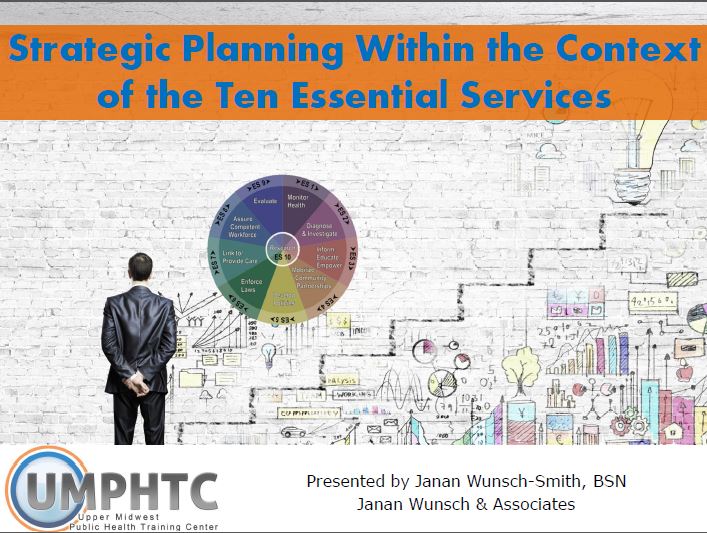
    • Discuss Public Health’s scope of practice (i.e. the Ten Essential Public Health Services).
    • Describe the rationale for Strategic Planning in Public Health.
    • Discuss the guiding principles of strategic planning.
    • Discuss the major questions that should be addressed during the strategic planning process.

    Pre-requisites/Learning Level

    No pre-requisites

    Competencies addressed

    • Analytical/Assessment Skills
    • Policy Development/Program Planning Skills
    • Leadership and Systems Thinking Skills

    CEUs Offered

    None

    Cost

    Free

    Modality/format

    Online Self-Pace

    Length

    1 hour

    Presenter(s) and/or Content Experts

    Janan Wunsch-Smith, BSN

    Technical requirements

    • Adobe Acrobat Reader 
    • Flash Player 
    • Speakers

    Registration requirements

    Register a free account

    Creation and/or update

    August 22, 2014

  • Health Literacy & Public Health:  Introduction

    Health Literacy & Public Health: Introduction

    This training:

    • Introduces the concept of health literacy.
    • Dispels common assumptions about people with low literacy.
    • Presents the consequences of low health literacy.
    • Describes public health activities with a health literacy perspective.

    This training is the first of two that address health literacy and public health. After completing this training, it is recommended that you enroll in Health
    Literacy & Public Health: Strategies for Addressing Low Health Literacy
    .

    This training contains four sections. The content and activities demonstrate how the public’s literacy skills affect interactions with medical and public health staff.

    Intended Audience:

    General

    Learning Objectives:

    After completing the course, the learner will be able to:

    • Define fundamental literacy.
    • Define health literacy.
    • Describe how health literacy relates to public health.
    • List the four domains of health literacy.
    • Give an example of each of the four domains of health literacy.
    • List some coping strategies people use to compensate for their low literacy skills.
    • List some groups that are more likely to be less literate.
    • List some reasons why people may have low literacy.
    • List the consequences of low health literacy for individuals.
    • Describe why people, regardless of literacy skills, may fail to understand health information.
    • Give examples of how low literacy affects the essential services of public health.

    Pre-requisites/Learning Level:

    No Pre-requisites

    Competencies addressed:

    CEUs Offered:

    CNE Credits offered until February 28, 2022. CHES, CME, and CPH credits offered until March 31, 2024

    Cost:

    Free

    Modality/format:

    Online Self-Pace

    Length:

    1 hour

    Presenter(s) and/or Content Experts:

    Technical requirements:

    • Adobe Acrobat Reader 
    • Speakers

    Registration requirements:

    Register a free account

    Creation and/or update: March 30, 2021

  • Health Literacy & Public Health: Strategies for Addressing Low Health Literacy

    Health Literacy & Public Health: Strategies for Addressing Low Health Literacy

    This training:

    • Provides strategies for considering literacy when creating public health messages for the general public.
    • Provides strategies for considering literacy in direct public health services to the public.

    This training, second in a series, contains two sections and provides practical techniques for addressing literacy issues in spoken and written communications. Be sure to sure to complete Health
    Literacy & Public Health: Introduction
     as a good primer.

    Intended Audience:

    General

    Learning Objectives:

    After completing the course, the learner will be able to:

    • List seven barriers to good communication in public health.
    • Provide an example for each barrier.
    • List seven techniques to improve health communication.
    • Define plain language.
    • Describe three communication strategies you can apply in your daily work.

    Pre-requisites/Learning Level:

    No Pre-requisites

    Competencies addressed:

    CEUs Offered:

    CNE Credits offered until February 28, 2022. CHES, CME, and CPH credits offered until March 31, 2024.

    Cost:

    Free

    Modality/format:

    Online Self-Pace

    Length:

    1 hour

    Presenter(s) and/or Content Experts:

    Technical requirements:

    • Adobe Acrobat Reader 
    • Speakers

    Registration requirements:

    Register a free account

    Creation and/or update: March 30, 2021

  • Practicing Cross-Cultural Communication: Community Health Worker

    Practicing Cross-Cultural Communication: Community Health Worker

    “Communicate to Make a Difference: Practicing Cross-Cultural Communication” is a collection of case studies that examine the practical application of the “Ten Strategies for Effective Cross-Cultural Communication,” as described in the “Exploring Cross-Cultural Communication” training. There are many facets of organizational culture. It is the awareness of these facets and how communication can affect an organization that is the focus of the “Community Health Worker Program” module. How can three different groups overcome communication challenges to work together?

    Intended Audience:

    Public health professionals including nurses, physicians, health educators.

    Learning Objectives:

    After working through this module, “Community Health Worker Program,” you will be better able to apply the following skills in your daily work:

    • Distinguish cultural perspectives.
    • Listen actively.
    • Recognize the complexity of cross-cultural communication.
    • Respect cultural differences.
    • Build self-awareness.
    • Ask questions to develop cultural knowledge.
    • Avoid stereotyping.
    • Flexibility in applying communication strategies.

    Pre-requisites/Learning Level:

    None

    Competencies addressed:

    CEUs Offered:

    CNE Credits offered until February 28, 2022. CHES and CME credits offered until May 31, 2023.

    Cost:

    Free

    Modality/format:

    Online Self-Pace

    Length:

    1 hour

    Presenter(s) and/or Content Experts:

    Technical requirements:

    • Adobe Acrobat Reader 
    • Speakers

    Registration requirements:

    Register a free account

    Creation and/or update: January 24, 2014

  • Nutrition and Oral Health for Children

    Keywords/Themes:

    aberrant dentin, achondroplasia, Angelman syndrome, angular cheiltis, anorexia nervosa, bulimia nervosa, bruxism, cachexia, calculus, candidiasis, deLange syndrome, dentin, dentifrice, diabetes, Down syndrome, early intervention services,enamel hypoplasia, fetal alcohol syndrome, fragile X syndrome, galactosemia, gastroesophageal reflux, gingiva, gingival hyperplasia, glossitis, glycogen storage disease, Head Start, HIV/AIDS, hypophosphatemia, Klinefelter syndrome, Lowe syndrome,malocclusion, mandible, marfan syndrome, Maxilla, Morphogenesis, Muscular dystrophy, neutropenia, organic acid disorders, Papillon-Lefevre syndrome, periodontal ligament, phenylketonuria, Rett syndrome, Smith-Lemli-Opitz syndrome, stomatitis, trisomy 18, urea cycle disorders, WIC, Williams syndrome, xerostomia

    Pre-requisites/Learning Level:

    None

    Competencies addressed:

    CEUs Offered:

    Prior approval for continuing education credit (1 hour per module) has been obtained for Registered Dietitians and dentists and other dental professionals. Other health professionals can request credit from their accrediting agencies.

    Cost:

    Free

    Modality/format:

    Online Self-Pace

    Length:

    1 hour

    Presenter(s) and/or Content Experts:

    Technical requirements:

    • Adobe Acrobat Reader 
    • Speakers

    Registration requirements:

    Register a free account

    Creation and/or update: January 24, 2014