Course Type: Course

  • Health Equity and Disability Training

    Health Equity and Disability Training

    Overview

    This series includes four units with a total of 11 sessions on different health equity and disability topics. 

    • Unit 1 includes two sessions introducing the series and overview to the Health Equity and Disability Training Series.
    • Unit 2 includes three sessions covering current trends, language and experience in culturally responsive care, and future trends.
    • Unit 3 includes three sessions covering historical and structural racism, brave spaces, and points of leverage.
    • Unit 4 includes three sessions covering disability and intersectionality, panel discussion of people with disabilities, and panel discussion with family members of people with disabilities.

    Intended Audience

    Healthcare providers and caregivers

    Pre-requisites/Learning Level

    Ability to read and understand spoken English

    Learning Objectives

    There are specific learning objectives for each session.

    CEUs Offered

    CEUs are not available for this training.

    Cost

    Free – there is no cost for this training.

    Modality/format

    Online self-paced, on demand.

    Length

    The total length of this series is between 3-3½ hours

    Creation Date

    August 2023 to December 2024

  • Office of Public Guardian Training

    Office of Public Guardian Training

    This section provides courses focused on the expectations and responsibilities of guardians and conservators, healthcare power of attorney, and general financial power of attorney. Additionally, it provides a general overview on guardianship and conservatorship, emphasizing the rights and autonomy of the protected person.

    The information contained in this course is intended for general informational purposes only and does not constitute legal advice. The law can change, so information in this course may not reflect the most up-to-date legal information. You should consult an attorney for advice about your specific legal matter. Use of and access to this course does not create an attorney-client relationship between you and the authors of this course. This course contains links to other third-party websites. The Iowa Department of Health and Human Services is not responsible for the content of those websites. Inclusion of links to other websites is for your information and convenience and does not constitute endorsement or recommendation by the Iowa Department of Health and Human Services.

  • Overview of Guardianship and Conservatorship in Iowa

    Overview of Guardianship and Conservatorship in Iowa

    This course offers an exploration of guardianships and conservatorships in Iowa, specifically for adults over the age of 18. It emphasizes the rights of the protected person and the critical responsibility of guardians and conservators to respect and preserve the individual’s autonomy whenever possible.

    Intended Audience

    Anyone who is interested in learning more about adult guardianships and conservatorships. This includes individuals serving in those roles or considering serving in those roles. It also includes healthcare professionals, aging and disability service providers, social workers, educators, and others who work with adults who have guardians or conservators.

    Course Objectives

    During this course, we will:

    • Review guardianship and conservatorship definitions
    • Identify alternatives to guardianship and conservatorship
    • Discuss the general responsibilties with each role

    Length

    [TBD]

    Course Content

    Key topics include:

    • Definitions and Appropriate Circumstances for Guardianship,
    • Alternatives and Legal Standards,
    • Decision-Making Capacity and Functional Limitations,
    • Third-Party Assistance and Advance Planning, and
    • Responsibilities of Guardians and Conservators.

    Competencies

    [TBD]

    Presenters and Content Experts

    Jennifer Donovan, JD, State Public Guardian, Iowa Department of Health and Human Services

    Meredith Saltzman, JD, Deputy Public Guardian, Iowa Department of Health and Human Services

    Acknowledgements

    Special thanks to Jayna Grauerholz, JD, Legal Assistance Developer, Iowa Department of Health and Human Services as well as board members of the Guardian Association of Iowa Network (GAIN) for their assistance in content review.

    HELP_TEXT

  • Guardianship in Iowa

    Guardianship in Iowa

    Category

    Supporting Individuals With Disabilities – Decision Making Supports or Supports for Decision Making

    Course Description

    This course outlines the role and responsibilities of a guardian in Iowa. This course provides the knowledge and skills necessary to fulfill your responsibilities effectively while respecting the rights and autonomy of the protected person.

    Intended Audience

    Anyone who is interested in learning more about adult guardianships, including the court process for appointing a guardian and the responsibilities a guardian has after they are appointed. This includes individuals serving as a guardian or considering
    serving as a guardian. It also includes healthcare professionals, aging and disability service providers, social workers, educators, and others who work with adults who have guardians.

    Course Objectives

    During this course, we will:

    • Understand what is expected of you as a guardian in Iowa,
    • Gain knowledge of your responsibilities to the protected person, and
    • Understand and know how to transfer rights between guardian and a protected person.

    Length

    25 minutes

    Course Content

    Key topics include:

    • Expectations of Guardians,
    • Responsibilities to the Protected Person, and
    • Responsibilities to the Court.

    Competencies

    N/A

    Presenters and Content Experts

    Jennifer Donovan, JD, State Public Guardian, Iowa Department of Health and Human Services

    Meredith Saltzman, JD, Deputy Public Guardian, Iowa Department of Health and Human Services

    Acknowledgements

    Special thanks to Jayna Grauerholz, JD, Legal Assistance Developer, Iowa Department of Health and Human Services as well as board members of the Guardian Association of Iowa Network (GAIN) for their assistance in content review.

    This training was supported by the Administration for Community Living (ACL), U.S. Department of Health and Human Services (HHS) as part of a financial assistance award totaling $24,999 with 100 percent funding by ACL/HHS. The contents are those of the
    author(s) and do not necessarily represent the official views of, nor an endorsement, by ACL/HHS, or the U.S. Government.

    The information contained in this course is intended for general informational purposes only and does not constitute legal advice. The law can change, so information in this course may not reflect the most up-to-date legal information. You should consult an attorney for advice about your specific legal matter. Use of and access to this course does not create an attorney-client relationship between you and the authors of this course. This course contains links to other third-party websites. The Iowa Department of Health and Human Services is not responsible for the content of those websites. Inclusion of links to other websites is for your information and convenience and does not constitute endorsement or recommendation by the Iowa Department of Health and Human Services.

  • Conservatorship in Iowa

    Conservatorship in Iowa

    Category

    Supporting Individuals With Disabilities – Decision Making Supports or Supports for Decision Making

    Course Description

    This course outlines the role and responsibilities of a conservator in Iowa. This course provides the knowledge and skills necessary to fulfill your responsibilities effectively while respecting the rights and autonomy of the protected person.

    Intended Audience

    Anyone who is interested in learning more about adult conservatorships, including the court process for appointing a conservator and the responsibilities a conservator has after they are appointed. This includes individuals serving as a conservator or
    considering serving as a conservator. It also includes healthcare professionals, aging and disability service providers, social workers, educators, financial professionals, and others who work with adults who have conservators.

    Course Objectives

    During this course, we will:

    • Identify what is expected of you as a conservator in Iowa,
    • Review the responsibilities to the protected person, and
    • Outline the process for seeking conservatorship.

    Length

    31 minutes

    Course Content

    Key topics include:

    • Expectations of Conservators,
    • Responsibilities to the Protected Person, and
    • Responsibilities to the Court.

    Competencies

    N/A

    Presenters and Content Experts

    Jennifer Donovan, JD, State Public Guardian, Iowa Department of Health and Human Services

    Meredith Saltzman, JD, Deputy Public Guardian, Iowa Department of Health and Human Services

    Acknowledgements

    Special thanks to Jayna Grauerholz, JD, Legal Assistance Developer, Iowa Department of Health and Human Services as well as board members of the Guardian Association of Iowa Network (GAIN) for their assistance in content review.

    This training was supported by the Administration for Community Living (ACL), U.S. Department of Health and Human Services (HHS) as part of a financial assistance award totaling $24,999 with 100 percent funding by ACL/HHS. The contents are those of the
    author(s) and do not necessarily represent the official views of, nor an endorsement, by ACL/HHS, or the U.S. Government.

    The information contained in this course is intended for general informational purposes only and does not constitute legal advice. The law can change, so information in this course may not reflect the most up-to-date legal information. You should consult an attorney for advice about your specific legal matter. Use of and access to this course does not create an attorney-client relationship between you and the authors of this course. This course contains links to other third-party websites. The Iowa Department of Health and Human Services is not responsible for the content of those websites. Inclusion of links to other websites is for your information and convenience and does not constitute endorsement or recommendation by the Iowa Department of Health and Human Services.

  • Healthcare Power of Attorney

    Healthcare Power of Attorney

    Category

    Supporting Individuals With Disabilities – Decision Making Supports or Supports for Decision Making

    Course Description

    This course presents the concept and importance of a durable power of attorney for healthcare. This course provides the knowledge and tools necessary to effectively utilize a durable power of attorney for healthcare, ensuring the principal’s wishes are
    respected and upheld.

    Intended Audience

    Anyone who is interested in learning more about the durable power of attorney for healthcare. This includes individuals considering signing a durable power of attorney for healthcare and individuals named as an attorney-in-fact in a durable power of attorney
    for healthcare. It also includes healthcare professionals, aging and disability service providers, social workers, and others who encounter durable powers of attorney for healthcare in their work.

    Course Objectives

    During this course, we will:

    • Define what a healthcare power of attorney is,
    • List the advantages of having a healthcare power of attorney,
    • Review what decisions an agent can make,
    • Describe how an agent makes decisions, and
    • Identify how a healthcare power of attorney can be revoked.

    Length

    10 minutes

    Course Content

    Key topics include:

    • Definition and Advantages,
    • Decision-Making Authority,
    • Timing of Decisions,
    • Decision-Making Process, and
    • Revocation Process.

    Competencies

    N/A

    Presenters and Content Experts

    Jennifer Donovan, JD, State Public Guardian, Iowa Department of Health and Human Services

    Meredith Saltzman, JD, Deputy Public Guardian, Iowa Department of Health and Human Services

    Acknowledgements

    Special thanks to Jayna Grauerholz, JD, Legal Assistance Developer, Iowa Department of Health and Human Services as well as board members of the Guardian Association of Iowa Network (GAIN) for their assistance in content review.

    This training was supported by the Administration for Community Living (ACL), U.S. Department of Health and Human Services (HHS) as part of a financial assistance award totaling $24,999 with 100 percent funding by ACL/HHS. The contents are those of the
    author(s) and do not necessarily represent the official views of, nor an endorsement, by ACL/HHS, or the U.S. Government.

    The information contained in this course is intended for general informational purposes only and does not constitute legal advice. The law can change, so information in this course may not reflect the most up-to-date legal information. You should consult an attorney for advice about your specific legal matter. Use of and access to this course does not create an attorney-client relationship between you and the authors of this course. This course contains links to other third-party websites. The Iowa Department of Health and Human Services is not responsible for the content of those websites. Inclusion of links to other websites is for your information and convenience and does not constitute endorsement or recommendation by the Iowa Department of Health and Human Services.

  • Illness & Injury Prevention Among Animal Caretakers

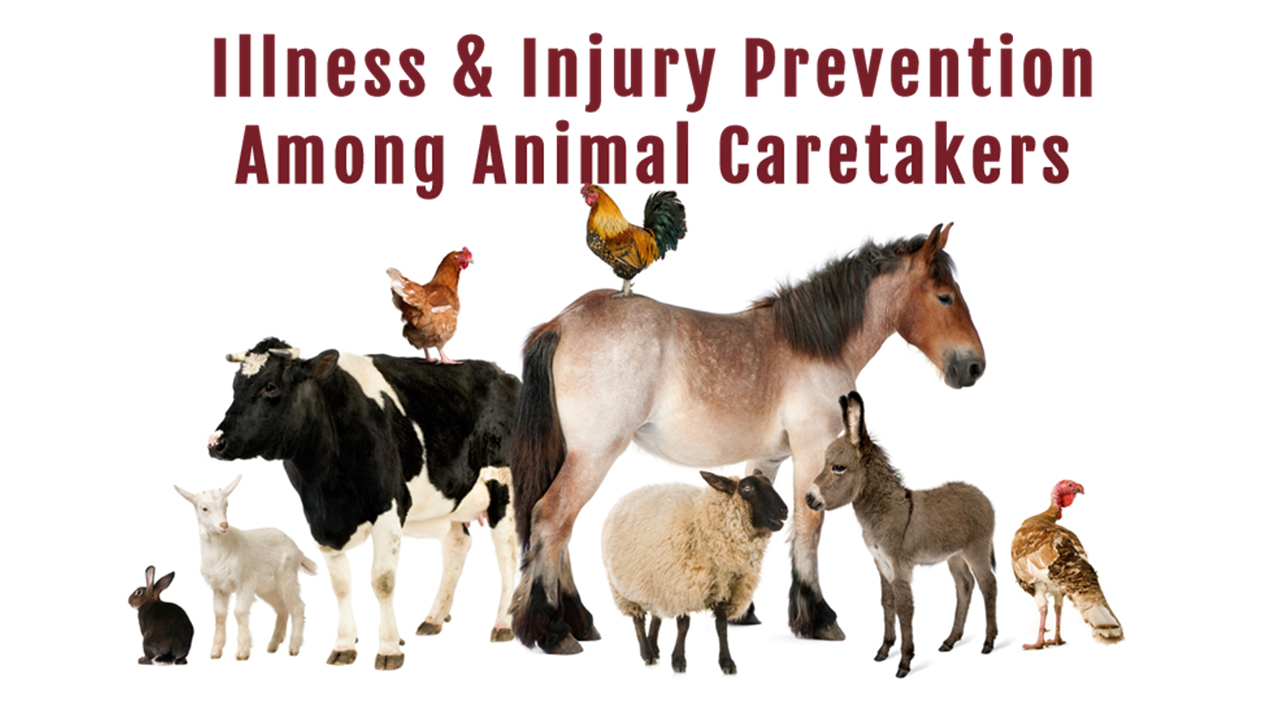
    Illness & Injury Prevention Among Animal Caretakers

    Overview

    The goal of Illness & Injury Prevention Among Animal Caretakers is provide a basic understanding of the hazards for individuals that handle or treat livestock on a regular basis. Animal caretakers engage in demanding tasks moving livestock and equipment
    and may be inadvertently kicked, bitten, or exposed to biological hazards.

    Intended Audience

    The intended audience for this course is rural health professionals.

    Length

    The length for this course is approximately 60 minutes depending on the individual user. Upon completion of the course, you will get a certificate of completion from the Great Plains Center of Agricultural Health at the University of Iowa College of Public
    Health.

    Prerequisite Requirement

    NA, however, it is advisable that you have some basic understanding of agricultural environment.

    Learning Objectives

    At the end of this course, you will be able to:

    • Describe the magnitude and impact of injury and illness among animal caretakers.
    • Recognize causes of injury and illness among animal caretakers.

    • Apply the Hierarchy of Controls, a framework to reduce exposure to hazards associated with animal caretaking.

    Core Competencies for Public Health Professionals

    Domain 3: Communication Skills

    3A2. Communicates in writing and orally with linguistic and cultural proficiency (e.g., using age-appropriate materials, incorporating images).

     Content

    Before you begin, please take the pretest. The pretest score will not be counted toward your final score.

    The content for this course is an overview and six topics covering musculoskeletal disorders, sharps injuries, hearing loss, dermatitis, respiratory disease, and fatigue/burnout.

    The course includes a learning module with interactivity and scenario application activities, a list of resources, and a posttest at the end of this course. A Certificate of Completion is awarded on successful completion of this course. In order to successfully
    complete this course, you MUST score 70% or higher on the posttest. If you do not receive 70% on the posttest, you may review the material and re-take it.

    Continuing Education Credit

    This course has been approved for continuing education credit for the following professions (details available in course materials):

    • Nurse/Nurse Practitioner – ANCC contact hour(s)
    • Pharmacist/Pharmacy Technician – ACPE contact hour(s)
    • Physician – AMA PRA Category 1 Credit(s)
    • Other Health Care Providers – A certificate of participation stating the number of AMA PRA Category 1 Credit(s)™ the course awards will be available after successful completion of the course. (It is the responsibility of licensees to determine if
      this continuing education activity meets the requirements of their professional licensure board.)

    A separate registration process will be required after successful completion of the course.

    Acknowledgements

    The following organizations collaborated on the development of this course: The Great Plains Center for Agricultural Health and the Midwestern Public Health Training Center, University of Iowa College of Public Health (MPHTC–UICPH).

    This project is supported by Grant Number 5 U54 OH007548-11 from the CDC – NIOSH for the Agricultural Medicine Core Course (Diane Rohlman, PI) a project within the Great Plains Center for Agricultural Health (Renee Anthony, PI).  Course contents
    are solely the responsibility of the authors and do not necessarily represent the official views of the CDC or NIOSH.


  • Changing Talk Online PPE

    Changing Talk Online PPE

    Goal

    The goal of this communication course is to increase awareness of the importance of effective communication with older adults while wearing personal protective equipment.

    Intended Audience

    The intended audience for this course is staff at nursing home facilities, independent and assistive living, and health care settings in the community that include registered nurses, nursing assistants, nursing home dieticians, direct care professionals, other administrations and support employees.

    Length

    The total program is approximately 30 minutes. The evaluation is approximately 10 minutes. Upon completion you will receive a certificate of completion.

    Learning Objectives

    After completing the CHATO program, participants will be able to:

    1. Identify the importance of communication with older adults while wearing PPE.
    2. Identify barriers to communication in care of older adults.

    The course content was presented by Dr. Kristine Williams (Dr. Williams’ Bio). There are learning activities, discussion forums, list of resources, posttest, and evaluations at the end of the course. The practice activities were designed to provide you with opportunities to apply the knowledge and skills presented in the course. Please take part in the discussion forum to share your experience and reflect on others.

    A Certificate of Completion is awarded on successful completion of this course.


    Acknowledgements

    This work was supported by the National Institute of Nursing Research of the National Institutes of Health under Award Number R01NR011455, Changing Talk to Reduce Resistiveness to Dementia Care, K. Williams, PI. The content is solely the responsibility of the authors and does not necessarily represent the official views of the National Institutes of Health.

  • WeSupportU Preventing Suicide

    WeSupportU Preventing Suicide

    This course is designed to be a recognition and referral training that allows each individual to help create communities of support for mental health, and decrease deaths of despair. The training focuses to increase understanding and awareness of suicide
    risk. Also, how to intervene when you are concerned about someone you know, connect them with resources, and offer support moving forward.

    Intended Audience

    All sectors in the community who are interested in mental health awareness/prevention and/or want to support a more resilience and compassionate workplace. This includes Healthcare professionals, public health workers, first responders, education, and
    beyond.

    Course Objectives

    • Define many topics related to suicide
    • How to indentify individuals who may be at an increased risk
    • Understand how to intervene and connect individuals with resources

    Length

    The length of time for participants to take this course is estimated to be 1.5 hours

    Course Content

    The course will cover the following:

    1. Information about suicide including warning signs, statistics, and risk and protective factors
    2. Intervention practice and resources for individuals who may be experiencing suicidal thoughts.
    3. Challenges to mental health stigma, and lived experience stories.
    4. Provide information for suicide loss survivors.

    Competencies

    COL Core Competencies for Public Health Professionals

    • Domain 1: Data Analytics and Assessment Skilss
      1.1 Describes factors that affect the health of community
    • Domain 2: Policy Development and Program Planning Skills
      2.3. Evaluates policies, programs, services, and organizational performance
    • Domain 3: Communication Skilss
      3A7. Facilitates communication among individuals, groups, and organizations
    • Domain 4: Health Equity Skills
      4.2. Engages in continuous self-reflection about one’s biases
      4.3. Recognizes the diversity of individuals and populations
    • Domain 5: Community Partnership Skills
      5.1. Describes conditions, systems, and policies affecting community health and resilience
    • Domain 6: Public Health Science Skills
      6.1. Describes systems, policies, and events impacting public health
      6.2. Applies public health sciences in delivering the 10 Essential Public Health Services
    • Domain 8: Leadership and Systems Thinking Skills
      8.1. Creates opportunities to achieve cross-sector alignment
      8.3. Addresses facilitators and barriers impacting delivery of the 10 Essential Public Health Services

    Presenter(s) and/or Content Experts

    • Jessica Provines, PhD, Assistant Vice President for Wellness and Chief Psychologist, Wichita State University
    • Marci Young, PsyD, Director of Prevention and Outreach, Counseling and Prevention Services, Wichita State University
    • Suzanne Hawley, PhD, MPH, Professor, Department of Public Health Sciences, Wichita State University

    Acknowledgements

    The following organizations collaborated on the development of this course:

    • Counseling and Prevention Services, Wichita State University (CAPS-WSU)
    • Midwestern Public Health Training Center (MPHTC)
  • Course 1: Introduction to CHW

    Course 1: Introduction to CHW

    Course 1: Introduction to Community Health Work: The Big Picture includes the following modules

    • Module 1: Role of Community Health Workers
    • Module 2: Evolution of the Community Health Worker
    • Module 3: Introduction to Public Health
    • Module 4: Healthcare and Health Policy
    • Module 5: Health Equity for All
    It should take approximately 4 hours to complete